

How to Teach "More Than" and "Less Than" to Your Grade 1 Child
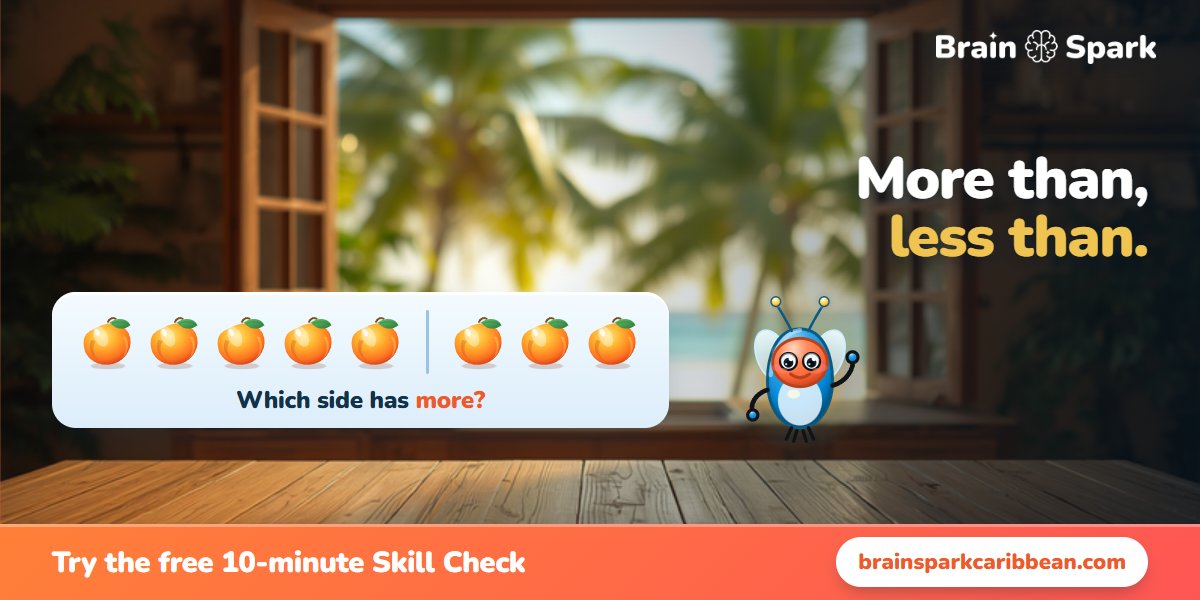
Your child already knows more than you think. When two children share out guineps and one pile looks bigger, your child notices in a heartbeat. That instinct is the start of real maths. "More than" and "less than" turn that gut feeling into something your child can count, explain, and trust.
This is one of the first big ideas in Grade 1, and it is worth getting right, because comparison sits underneath addition, subtraction, and later the harder maths. The good news is you do not need worksheets or pressure. You need about ten mangoes and ten calm minutes.
Why "more than" and "less than" matter more than they look
Comparing amounts is how children learn that numbers have size, not just names. A child who can look at two groups and say which has more, and prove it, is building number sense. A child who only guesses is building a habit of guessing. The difference shows up years later, so the early minutes count.
Keep it warm. This is not a test. It is a game you play together at the table.
Start with real objects your child can touch
Screens can come later. Begin with things from around the house: mangoes, dry beans, dominoes, small stones, or bottle caps. Put out two groups, for example five mangoes on one side and three on the other. Let your child move them around. Maths that a child can touch is maths a child remembers.
Step 1: Count both groups out loud
Point to each mango and count together, one number for each: "one, two, three, four, five." Then the other group: "one, two, three." Say the numbers slowly and let your child do the pointing. This is the count-along, and it does something important. It stops your child from guessing and gets them looking at the actual amount. If the counting itself still wobbles, our guide on teaching your child to count (really count) pairs well with this one.
Step 2: Match them one to one
Here is the move that makes it click. Line the two groups up in two rows, one mango under another. When your child pairs them off, some mangoes on the bigger side have no partner. Those leftover ones are the proof.
Now your child can say it and mean it: "Five is more than three, because two are left over." Turn it around so both words live in the same picture: "And three is less than five." The shorter row is less. Same two groups, two ways to say it.
Step 3: The hungry-mouth trick for the signs
When your child is ready for the symbols, give them a picture they will not forget. The greater-than and less-than signs are like a hungry mouth, and the mouth always opens toward the bigger group. Five is more than three, so the mouth opens to the five. Draw it together: 5 > 3. Then a smaller-first one: 3 < 5. The mouth still opens to the bigger number. Children love this because it turns a confusing symbol into a simple rule they can check every time.
A two-minute game to play at home
Make it a habit, not a lesson. At the market, ask "which tray has more mangoes?" and count to check. On the step, share out dominoes and ask "who has more, and how do you know?" The magic phrase is always "how do you know?" It moves your child from guessing to proving, which is the whole point.
Keep the numbers small at first, up to ten, then stretch a little as your child grows confident.
Signs your child is guessing, not understanding
Watch for these, gently:
- Your child names the bigger group instantly but cannot count to show why.
- The answer changes when you rearrange the same objects into a longer, spread-out line.
- Your child is right with five and three but lost with six and seven.
None of these mean your child is behind. They mean the one-to-one matching in Step 2 needs a few more turns. Slow down, count together, and let the leftovers do the teaching.
See the same idea in Brain Spark
This is exactly what your child taps through in Brain Spark, comparing two groups and choosing the one with more, then seeing straight away whether they were right. Same thinking, no mangoes to wash afterwards. Brain Spark is coming soon, with maths adventures for Grades 1 to 6.
The best way to see where your child's number sense is right now is the free Skill Check. It takes about ten minutes, needs no signup, and shows you what your child has already mastered and what to practise next.
Frequently asked questions
At what age should a child learn more than and less than?
Most children begin comparing small groups between ages five and six, in Grade 1. Start with amounts up to ten that your child can count and touch, and grow the numbers as their confidence grows.
What is the easiest way to teach the greater-than and less-than signs?
Show the sign as a hungry mouth that always opens toward the bigger group. For 5 and 3, the mouth opens to the 5, so 5 is greater than 3. Children can check it themselves every time, which builds confidence.
My child guesses instead of counting. What should I do?
Line the two groups up one under the other and pair them off. The leftover objects on the bigger side are the proof. Ask "how do you know?" so your child learns to show the answer, not just say it.
Do I need an app to teach this?
No. A handful of mangoes, beans, or dominoes is enough to teach it well. An app like Brain Spark helps your child practise the same idea on their own and shows you exactly where they are, but the kitchen table comes first.
Ready to help your child build a strong math foundation?
Caribbean exam-aligned practice for CPEA, SEA, NGSA, PEP, BJE, PSE, GLAT, and more. Free 7-day trial. 10 questions per child per day. No credit card needed.
Start the Free Skill Check