

How to Teach Skip Counting in 2s, 5s and 10s at Home
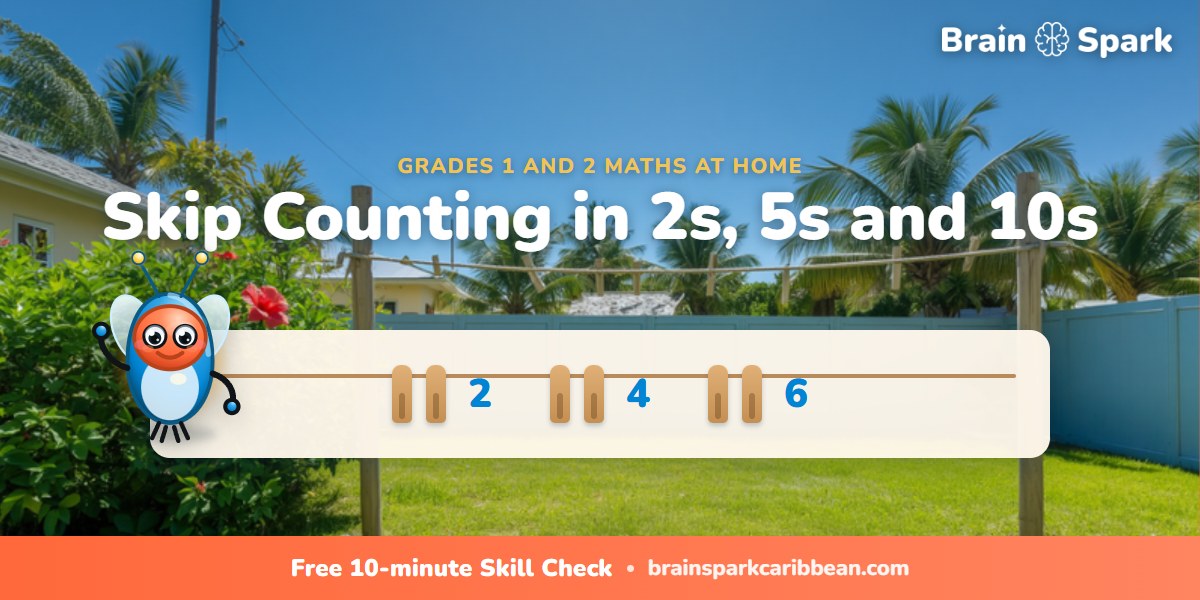
Skip counting is counting in equal jumps instead of one at a time: 2, 4, 6, 8, or 5, 10, 15, 20. It sounds like a chant, but it is really your child's first taste of multiplication. A child who can skip count with understanding is halfway to their times tables before anyone calls them that.
The trap is that many children learn the chant without the meaning. They can sing "two, four, six, eight" and still have no idea it counts anything. The fix is to hang the numbers on real things, and the Caribbean yard is full of them. If counting one at a time is still wobbly, start there first; skip counting stands on it.
What is skip counting?
Skip counting means counting forward in equal groups instead of by ones: by 2s (2, 4, 6, 8), by 5s (5, 10, 15, 20), or by 10s (10, 20, 30, 40). Each number you say is a running total of equal groups, which is why skip counting is the foundation for multiplication in later grades.
Count in 2s on the clothes line
Next time you hang washing together, put two pegs on every garment. Then walk the line and count pegs, two at a time, touching them as you go: "two, four, six, eight." Every shirt adds exactly two, and your child can see why the numbers jump.
Then ask the question that turns a chant into thinking: "Four shirts on the line. How many pegs?" Let your child walk the line and check. The line never lies.
Count in 5s with hibiscus blooms
A hibiscus flower has five petals, every single time. Pick up fallen blooms, or draw them, and count petals bloom by bloom: "five, ten, fifteen." Three blooms, fifteen petals. Your child is not reciting a list; they are counting real petals in real groups of five.
Hands work the same magic. Every person in the family holds up one hand: five, ten, fifteen, twenty. Granny visiting? Twenty-five.
Count in 10s with bead strings
Thread ten beads on a string, and make a few strings. Now count strings, not beads: "ten, twenty, thirty." When your child asks to check, count one string bead by bead so they trust that every string really holds ten. This is the same ten from number bonds doing bigger work, and it is why counting in 10s feels so clean: the tens digit climbs by one while the ones digit stays put.
The freeze game
Here is the two-minute game that locks it in. Skip count out loud together, and at a random moment say "freeze." Your child has to say how many things you have counted so far, not just the last number. Counting pegs in 2s and you freeze at "eight"? That is four shirts. Freeze at "fifteen" in 5s? Three blooms.
The freeze question is the whole lesson in disguise: it checks that each number stands for a pile of real things, not just the next word in a song.
Signs your child is chanting, not counting
Watch for these, gently:
- Your child can say "5, 10, 15, 20" but cannot tell you how many blooms that is.
- Starting anywhere except the beginning breaks the chain. Ask them to count on from 10 in 2s and see.
- Counting backwards in the same jumps is a mystery.
None of these mean your child is behind. They mean the numbers need to go back on real objects for a while. Chant plus objects makes meaning; chant alone makes noise.
See the same idea in Brain Spark
This is exactly what your child taps through in Brain Spark: finishing number patterns, spotting the jump size, and counting groups with a cheer when it clicks. Same thinking, no wet washing involved. Brain Spark is coming soon, with maths adventures for Grades 1 to 6.
The best way to see where your child's number sense is right now is the free Skill Check. It takes about ten minutes, needs no signup, and shows you what your child has already mastered and what to practise next.
Frequently asked questions
What is skip counting?
Skip counting is counting forward in equal jumps instead of by ones: by 2s (2, 4, 6, 8), by 5s (5, 10, 15, 20), or by 10s (10, 20, 30, 40). Each number is a running total of equal groups, which makes it the foundation for multiplication.
What age should a child learn skip counting?
Children usually start skip counting by 2s, 5s and 10s in Grades 1 and 2, around ages five to seven, once counting by ones is solid. Begin with 10s and 5s, which follow the clearest pattern, then move to 2s.
How is skip counting connected to multiplication?
Skip counting is multiplication in slow motion. Saying "five, ten, fifteen" while counting three blooms is the same as three groups of five. A child who skip counts with real objects already understands what the times tables mean.
My child can chant the numbers but cannot answer questions. Is that normal?
Yes, and it is the most common stage. Put the numbers back on real objects: pegs in twos, petals in fives, bead strings in tens. Then play freeze: stop mid-count and ask how many things you have counted so far.
Ready to help your child build a strong math foundation?
Caribbean exam-aligned practice for CPEA, SEA, NGSA, PEP, BJE, PSE, GLAT, and more. Free 7-day trial. 10 questions per child per day. No credit card needed.
Start the Free Skill Check