

How to Teach Tally Marks to Your Grade 1 Child (Count by 5s)
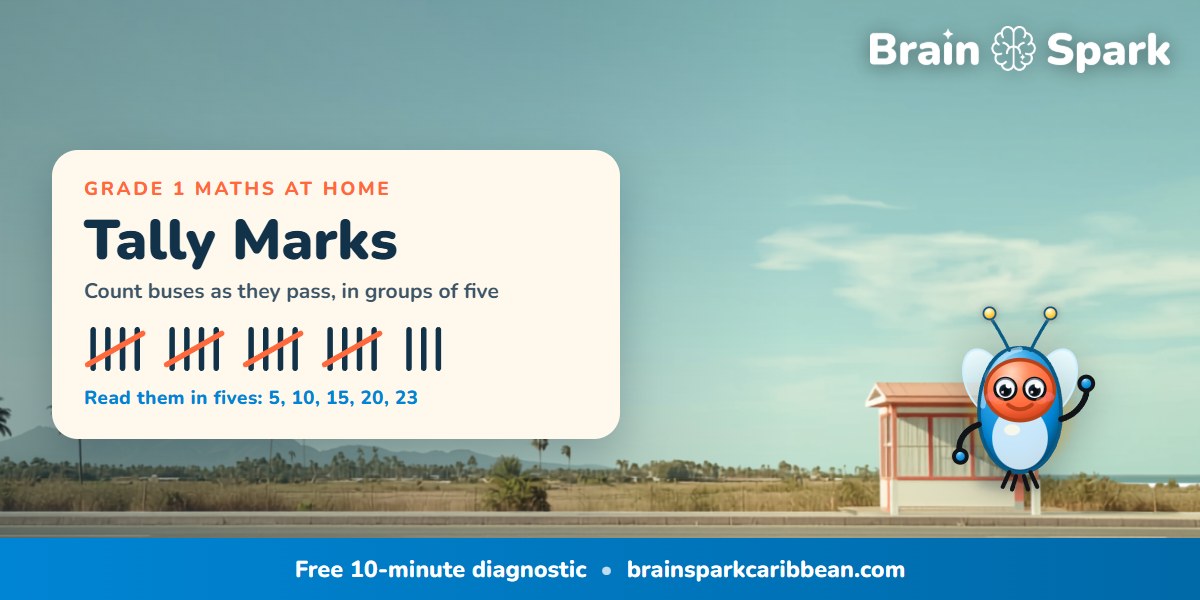
Tally marks solve a problem every child meets before they can name it: how do you count things that will not sit still?
You cannot line up the buses going past the stop and count them afterwards. They are gone. So you make one mark for each one as it passes, and you read the marks later. That is the whole idea, and a child can hold it in about ten minutes.
What a tally mark is
A tally mark is one stroke standing for one thing. Four upright strokes, then a fifth stroke drawn diagonally across the four to close the group.
That fifth stroke is the part that matters, and it is the part most children skip. Without it you have a field of identical lines that has to be counted one by one, which is exactly the work you were trying to avoid. With it, every closed group is worth five, and your child counts five, ten, fifteen instead of one, two, three.
Tally marks are really two skills wearing one coat: recording as things happen, and counting in fives. The second is why this sits so close to skip counting.
Do it at the bus stop
Sit where you can see the road, or wait with your child at a stop. Give your child a sheet of paper and a pencil.
The rule is one mark for each bus that passes, drawn as it passes, not afterwards. Say it out loud the first few times so the rhythm sets: mark, mark, mark, mark, and the fifth one goes across.
Ten minutes is plenty. When you stop, do not let your child count the strokes one at a time. Point at the first closed group and ask what it is worth. Five. The next one. Ten. Keep going, then add whatever loose strokes are left at the end.
A child who has just read twenty-three buses off a page in about four seconds has understood why anyone bothers with tally marks. You do not have to explain the point. They felt it.
What usually goes wrong
The fifth stroke goes missing. This is the most common one by a distance. Watch for four upright strokes followed by a fifth upright stroke. Ask your child to count that group and they will get five either way, so the error hides. It only shows up later, on a page of forty marks that takes a minute to count. Catch it early by making the diagonal stroke a small ceremony: pause, say "and across", draw it.
Marks get drawn afterwards from memory. A child who waits and then draws six marks because they think six buses went past has done a memory exercise, not a data exercise. The mark goes down as the thing happens. If they miss one, they miss one. That is honest data, and honest data is the lesson.
Counting the groups instead of counting in fives. Three closed groups is fifteen, not three. Ask how many buses, not how many groups, and make your child answer in buses.
Say it like this at home
You do not need teaching language. These work:
- One mark each time. Do not wait.
- Four up, then one across. That is a five.
- Now count the fives out loud: five, ten, fifteen.
- How many altogether? Not how many groups, how many buses.
Turn the marks into a picture
Once the counting is comfortable, do it twice and compare. Ten minutes in the morning, ten minutes in the evening. Two numbers, side by side.
Now your child has something to say: more buses pass in the evening than in the morning. That sentence is the beginning of data handling, and it is the part that matters most later on. Anyone can count. Reading what the count means is the skill.
If they enjoy it, draw one picture for every five buses instead of writing the number. That is a pictograph, and your child has now built one from their own data rather than reading a chart made by somebody else.
Where this goes next
Tally marks feed straight into charts, pictographs and tables, and the counting in fives feeds straight into skip counting and later into times tables. It is a small skill that quietly sits under a lot of later work, which is why it is worth the ten minutes now rather than the hour later.
Common questions
What age should a child learn tally marks?
Most Caribbean children meet tally marks in Grade 1 and use them properly by Grade 2, once counting in fives is comfortable. If your child can count to twenty reliably, they are ready.
Why group tally marks in fives and not tens?
Five is the largest group most people can recognise at a glance without counting, and it matches one hand. Groups of ten are harder to read at speed and easier to draw wrong.
My child draws the fifth mark upright instead of across. Does it matter?
Yes, though not for the reason children assume. Both versions give five marks. The diagonal stroke is what lets you read the page in fives later without recounting. Fix it early; it is a hard habit to unpick once a child has drawn a hundred of them.
What if my child misses some while counting?
Let them. A tally that missed two buses is a real record with a real limitation, and noticing that is worth more than a tidy number they invented afterwards.
Ready to help your child build a strong math foundation?
Caribbean exam-aligned practice for CPEA, SEA, NGSA, PEP, BJE, PSE, GLAT, and more. Free 7-day trial. 10 questions per child per day. No credit card needed.
Start the Free Skill Check