

How to Teach Number Bonds to 10 to Your Grade 1 Child
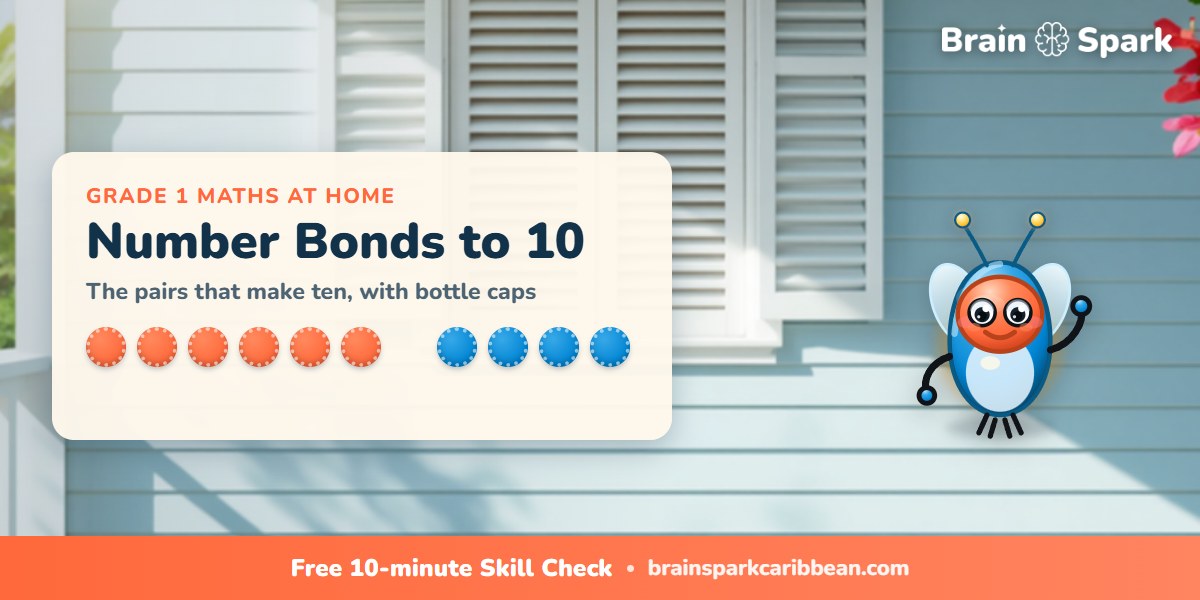
Number bonds to 10 are the pairs of numbers that make ten together: 6 and 4, 7 and 3, 8 and 2. A child who knows these pairs by heart does not count from one every time. They see ten hiding inside every sum, and that one habit makes addition and subtraction feel light instead of heavy.
This is one of the most useful things a Grade 1 child can learn, and you can teach it at the kitchen table with ten bottle caps and about ten calm minutes.
What is a number bond to 10?
A number bond to 10 is a pair of numbers that add up to exactly ten. There are only a handful of them: 0 and 10, 1 and 9, 2 and 8, 3 and 7, 4 and 6, and 5 and 5. Once a child knows these pairs, they can use them everywhere, because our whole number system is built around ten.
Think of each pair as partners. Six needs four to make ten. Nine needs one. When your child knows every number's partner, sums like 8 + 5 stop being a long count and become a quick two-step: 8 takes 2 to reach ten, then 3 more makes 13.
Start with ten bottle caps your child can touch
Collect ten bottle caps, the same kind if you can. Count them together first, pointing to each one: "one, two, three," all the way to ten, so your child trusts that there are ten and exactly ten. If you read our guide on teaching your child to count, this is the same count-along habit doing new work.
Step 1: Split the ten and count both parts
Push the ten caps into two groups, any two groups. Say your child splits them into six and four. Count the first group together: "one, two, three, four, five, six." Count the second: "one, two, three, four." Then say the whole sentence out loud: "Six and four make ten."
Now split them a different way and do it again. Seven and three make ten. Two and eight make ten. Let your child do the splitting. Every split is a new bond, and the caps prove it every time.
Step 2: The hide-some game
This is where the pairs move from the table into your child's head. You take the ten caps, hide some under a cup, and leave the rest showing. Ask: "How many are hiding?"
If your child sees six, they work out that four are hiding, because six and four make ten. At first they will count up from six on their fingers: "seven, eight, nine, ten, that is four more." That counting-up is exactly right. After a few days of the game, the answer starts arriving before the counting does. That is the bond forming.
Then swap roles and let your child hide caps from you. Get one wrong on purpose and let them catch you. Children love being the teacher, and explaining why you are wrong is the deepest practice there is.
Step 3: The two-hands trick
Your child carries a number-bond machine everywhere: their hands. Ten fingers, always ten. To find the partner of any number, hold up all ten fingers, fold down the number you have, and the fingers still standing are the partner.
Partner of 7? Fold down seven fingers, three are standing, so 7 and 3 make ten. Partner of 4? Fold down four, six standing. Your child can check any bond, any time, in the market or on the bus, with no caps needed. That self-checking is what turns a trick into confidence.
A two-minute game for busy days
You do not need a sitting every day. Just throw out a number and ask for its partner: "Nine!" and your child answers "One!" Do it while walking to school or sharing out dinner. Keep score of streaks if your child enjoys that, and let the two-hands trick settle any argument.
If your child still finds comparing groups shaky, play a round of more than and less than first; bonds land easier when a child can already see which group has more.
Signs your child is memorising sounds, not seeing pairs
Watch for these, gently:
- Your child chants "six and four" but cannot show it with the caps.
- The hide-some game falls apart when you change how many are hiding.
- Partners come fast for 5 and 5 but nothing else.
None of these mean your child is behind. They mean the caps need to come back out for a few more rounds. The objects are not the baby step; they are where the understanding lives. Speed comes after seeing, never before.
See the same idea in Brain Spark
This is exactly what your child taps through in Brain Spark: making tens, splitting tens, and spotting the partner, with a cheer when it clicks. Same thinking, no caps rolling off the table. Brain Spark is coming soon, with maths adventures for Grades 1 to 6.
The best way to see where your child's number sense is right now is the free Skill Check. It takes about ten minutes, needs no signup, and shows you what your child has already mastered and what to practise next.
Frequently asked questions
What are the number bonds to 10?
The number bonds to 10 are the pairs that add up to ten: 0 and 10, 1 and 9, 2 and 8, 3 and 7, 4 and 6, and 5 and 5. Children who know these pairs can add and subtract without counting from one each time.
At what age should a child learn number bonds to 10?
Most children learn number bonds to 10 in Grade 1, around ages five to six, once they can count ten objects confidently. Start with real objects your child can split into two groups, and let quick recall grow out of that.
What is the easiest way to practise number bonds at home?
Play the hide-some game. Take ten bottle caps, hide some under a cup, and ask how many are hiding. Your child uses the caps they can see to work out the partner. Two minutes a day beats one long session a week.
Why are number bonds to 10 so important?
Our number system is built around ten, so every bigger sum leans on these pairs. A child who knows 8 needs 2 to make ten can solve 8 + 5 as ten and three more. Bonds turn slow counting into quick, confident steps.
Ready to help your child build a strong math foundation?
Caribbean exam-aligned practice for CPEA, SEA, NGSA, PEP, BJE, PSE, GLAT, and more. Free 7-day trial. 10 questions per child per day. No credit card needed.
Start the Free Skill Check