

How to Teach Your Grade 1 Child to Count (Really Count)
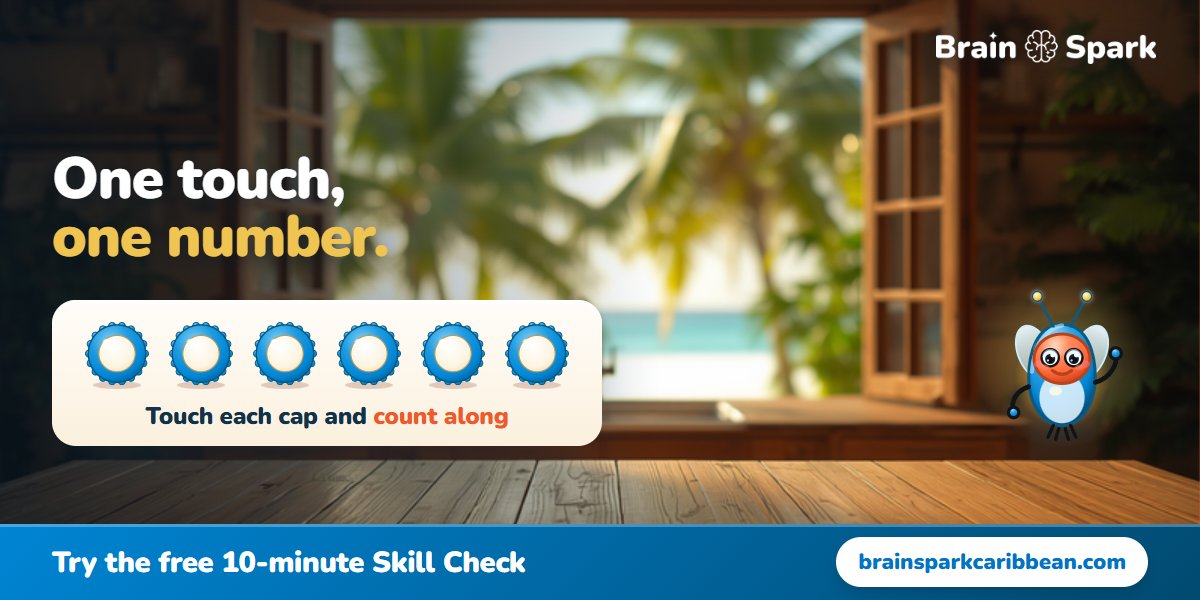
Here is a small surprise many parents meet in Grade 1. A child can sing the numbers all the way to twenty, clear and proud, and still not be able to count seven bottle caps on the table. Saying numbers and counting things are two different skills. The first one is a song. The second one is maths.
The good news is that the gap closes fast once you know what to practise. You do not need worksheets or flash cards. You need a handful of bottle caps, guineps (chenets or skin-ups, depending on your island), or dominoes, and about ten calm minutes at the table.
What "really counting" means
Real counting is three small skills working together:
- The numbers come in a fixed order. One, two, three, always in the same sequence. Most children pick this up first, from songs and games.
- One touch, one number. Each object gets exactly one number, no skips, no repeats. Teachers call this one-to-one correspondence, and it is where most Grade 1 counting wobbles.
- The last number tells the whole story. After counting "one, two, three, four, five," a child who really counts knows there are five. A child who is still learning will count the group all over again when you ask "so how many?"
A child who has all three is not just saying numbers. They are measuring the world.
Step 1: Count with your finger, not just your voice
Put out a small group of bottle caps, six or so, in a line. Count together, and make the rule physical: touch each cap as you say its number. "One, two, three, four, five, six." One touch, one number. Let your child do the touching while you say the numbers together, then let them do both.
The touching is not babyish. It is the whole trick. It ties each spoken number to exactly one object, which is the difference between counting and reciting.
Step 2: Ask "so how many?" and watch what happens
When the count ends, ask "so how many bottle caps?" If your child answers straight away with the last number they said, the idea has landed. If they start counting again from one, that is completely normal. It just means the last piece is still settling.
Help it settle with one gentle move: when the count finishes, sweep your hand around the whole group and say "six. The whole group is six." The last number is not just the end of the song. It is the name of the group.
Step 3: Spread them out and ask again
Now the fun part. Spread the same six caps into a long line and ask, "how many now?" Many young children will say there are more, because the line looks longer. Do not correct with words. Correct with counting: touch and count together, and let the answer be the proof. Same caps, same six.
This little game builds a deep idea, that the amount stays the same no matter how the objects are arranged. It is worth playing often, with the caps close together, far apart, in a circle, in a pile.
A two-minute game for the market
Counting practice hides everywhere once you look. At the market, ask your child to count out four mangoes into the bag, one touch, one number. On the step, count the dominoes into two piles. Sharing guineps? "Count out five for your sister." Asking a child to count out an exact amount is harder than counting what is already there, and it is the best quick test of real counting you have.
Keep the numbers small, up to ten at first. Confidence grows faster than range, and range follows.
Signs your child is reciting, not counting
Watch for these, gently:
- The voice runs ahead of the finger, saying numbers faster than they touch.
- Some objects get skipped, or one object gets counted twice, without your child noticing.
- They can say numbers to twenty but cannot hand you exactly six bottle caps.
- When you ask "how many?" right after a count, they start again from one, every time.
None of these mean your child is behind. They mean the one-touch-one-number habit needs more turns. Slow the count down, make the touching bigger, and play the spread-out game again. If maths time brings worry with it, our guide on building maths confidence pairs well with this one.
See the same idea in Brain Spark
This is exactly what children practise in Brain Spark, tapping each object to count it, with Sparky the firefly counting along out loud. Same one-touch-one-number habit, no bottle caps to tidy up afterwards. Brain Spark is coming soon, with maths adventures for Grades 1 to 6.
The best way to see where your child's counting is right now is the free Skill Check. It takes about ten minutes, needs no signup, and shows you what your child has already mastered and what to practise next.
Frequently asked questions
At what age should a child be able to count to 20?
Most children can say the numbers to 20 between ages four and six. Counting 20 objects accurately, with one number for each object, usually comes a little later, in Grade 1. Both are normal, and the second skill is the one worth practising at the table.
My child can say the numbers but cannot count objects. Is that normal?
Yes, very. Reciting the number sequence and counting real things are different skills, and the sequence almost always comes first. Practise one-to-one counting: touch each object while saying its number, slowly, with small groups of up to ten.
What is one-to-one correspondence in counting?
One-to-one correspondence means giving each object exactly one number when counting, no skips and no repeats. It is the skill that turns reciting into real counting. Children build it by touching or moving each object as they say its number.
How can I practise counting at home without worksheets?
Use things your child can hold: bottle caps, dominoes, guineps, mangoes at the market. Ask your child to count out an exact amount, for example "count out five for your sister," and play the spread-out game: count a group, rearrange it, and count again to see the number stays the same.
Ready to help your child build a strong math foundation?
Caribbean exam-aligned practice for CPEA, SEA, NGSA, PEP, BJE, PSE, GLAT, and more. Free 7-day trial. 10 questions per child per day. No credit card needed.
Start the Free Skill Check